> ## Documentation Index
> Fetch the complete documentation index at: https://docs.shipthing.com/llms.txt
> Use this file to discover all available pages before exploring further.
# Configuration
> Configure billing for your application.
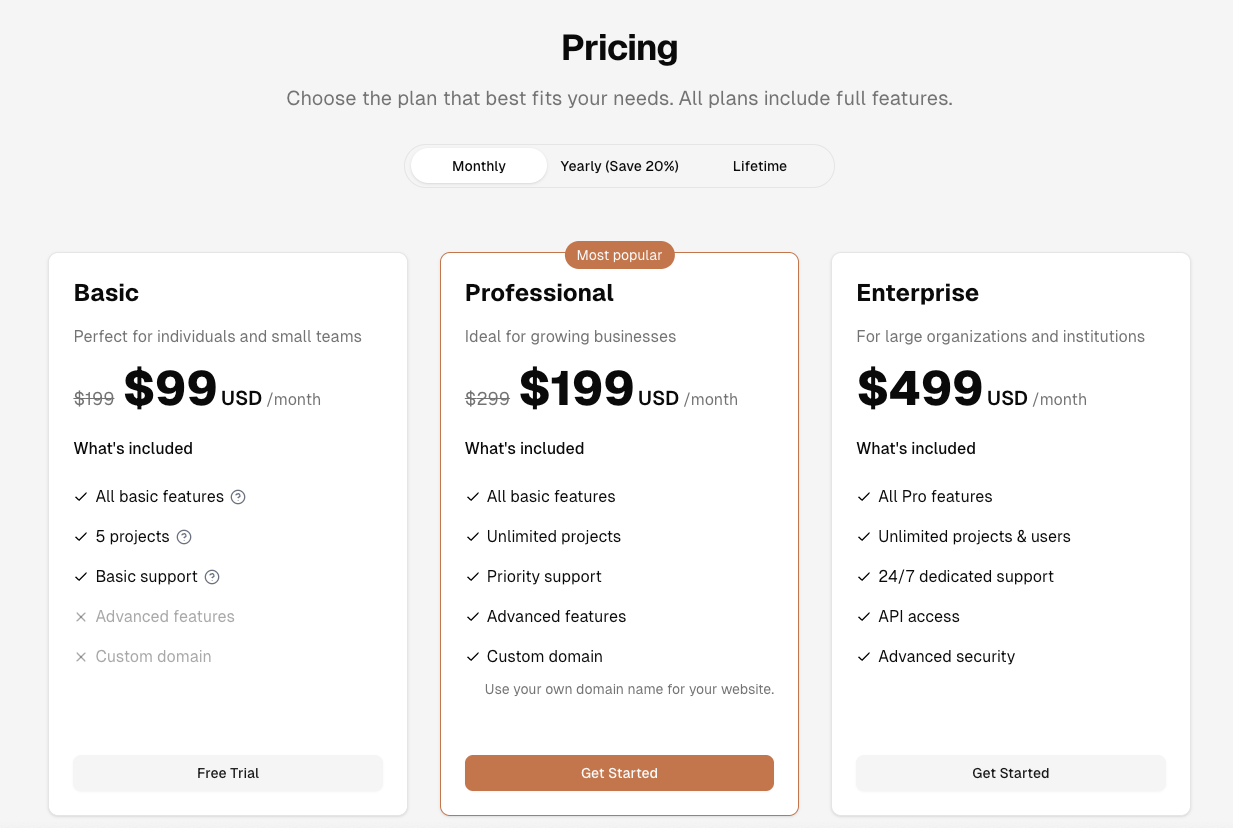 The billing configuration schema replicates your billing provider's schema, so that:
* we can display the data in the UI (pricing table, billing section, etc.)
* create the correct checkout session
* make some features work correctly - such as feature-based access
It is common to all billing providers and placed in `apps/web/config.ts`. We can see the schema in the `packages/design-system/types/pricing.d.ts` package. Let me show you some important parts:
## Billing model
```ts theme={"system"}
export type PaymentType = 'one-time' | 'month' | 'year';
```
This is the billing model of your product. It can be one of the following:
* `one-time`: The product is one-time purchase.
* `month`: The product is subscription-based and renews monthly.
* `year`: The product is subscription-based and renews yearly.
## Prices
```ts theme={"system"}
export interface PricingItem {
title: string;
price: number;
priceId: string;
description?: string;
featuresTitle?: string;
actionTitle?: string;
features?: Feature[];
interval: PaymentType;
isPopular?: boolean;
badge?: BadgeProps;
group?: string;
credits?: number;
originalAmount?: number;
validMonths?: number;
amount?: number;
onMmount?: number;
attribute?: Record; // your custom data
}
```
`priceId` is the ID of the price in your billing provider. It is used to create the checkout session and to display the correct price in the UI.
`priceId` from the provider (e.g. Stripe) or `variantId` (e.g. Lemon Squeezy) , some providers use `productId` instead of `priceId`. Just use `priceId` to store it.
The billing configuration schema replicates your billing provider's schema, so that:
* we can display the data in the UI (pricing table, billing section, etc.)
* create the correct checkout session
* make some features work correctly - such as feature-based access
It is common to all billing providers and placed in `apps/web/config.ts`. We can see the schema in the `packages/design-system/types/pricing.d.ts` package. Let me show you some important parts:
## Billing model
```ts theme={"system"}
export type PaymentType = 'one-time' | 'month' | 'year';
```
This is the billing model of your product. It can be one of the following:
* `one-time`: The product is one-time purchase.
* `month`: The product is subscription-based and renews monthly.
* `year`: The product is subscription-based and renews yearly.
## Prices
```ts theme={"system"}
export interface PricingItem {
title: string;
price: number;
priceId: string;
description?: string;
featuresTitle?: string;
actionTitle?: string;
features?: Feature[];
interval: PaymentType;
isPopular?: boolean;
badge?: BadgeProps;
group?: string;
credits?: number;
originalAmount?: number;
validMonths?: number;
amount?: number;
onMmount?: number;
attribute?: Record; // your custom data
}
```
`priceId` is the ID of the price in your billing provider. It is used to create the checkout session and to display the correct price in the UI.
`priceId` from the provider (e.g. Stripe) or `variantId` (e.g. Lemon Squeezy) , some providers use `productId` instead of `priceId`. Just use `priceId` to store it.